1. Residential Metal Roofing Surges to 14%–18% Market Share (Up 4x Since 2000)
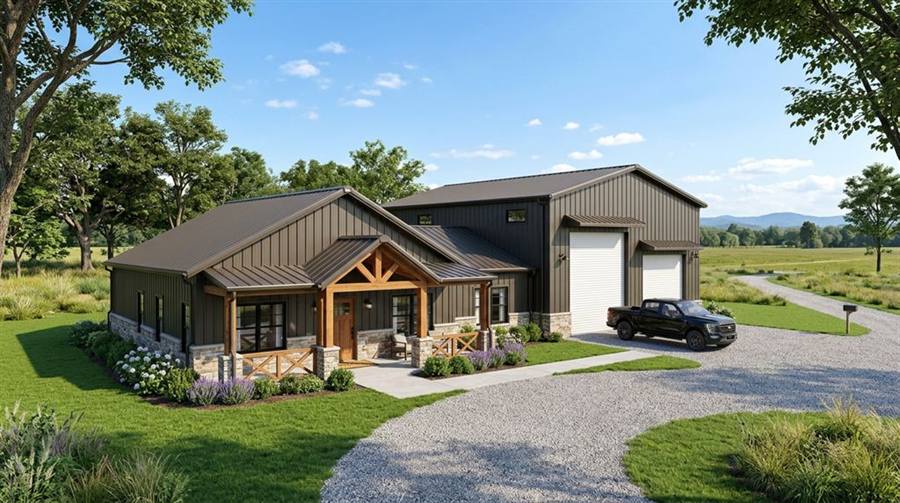
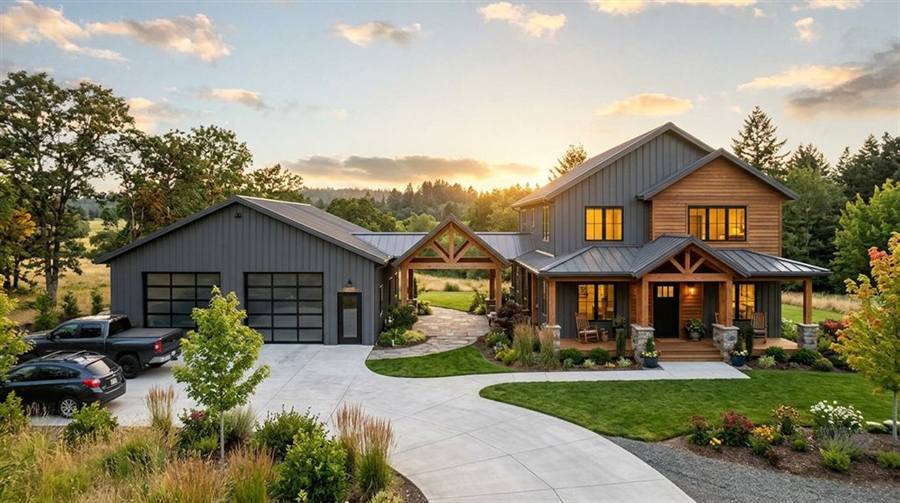
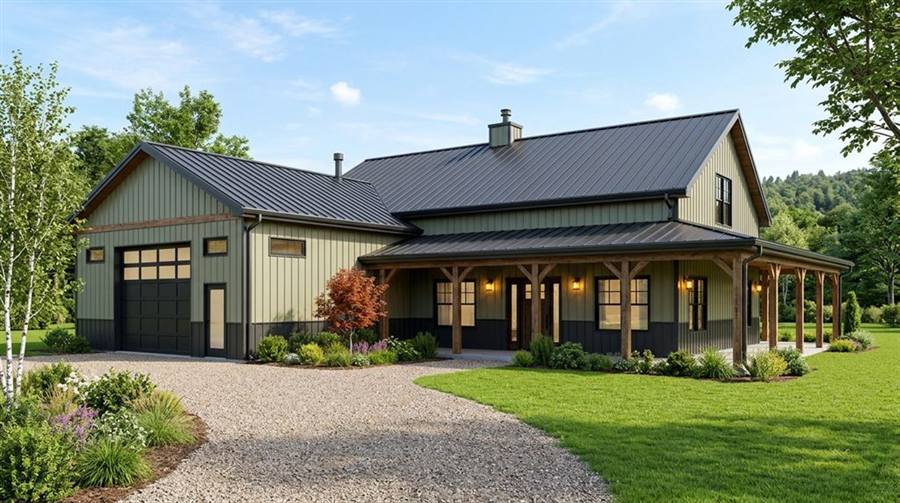
Metal roofing is no longer reserved for agricultural barns and industrial warehouses. According to the Metal Roofing Alliance (MRA), residential metal roofing now captures 14% to 18% of all U.S. re-roofing and custom home builds—more than quadrupling its 3% to 5% market share in 2000, with coated steel accounting for 82% of all residential metal installations. Across Barndominium and Pole Barn Home builds in HoolieHaus's 2,062-plan catalog, standing-seam and ribbed steel panels represent the default structural envelope.
The driver is simple lifecycle math combined with severe-weather underwriting. While architectural asphalt shingles require full tear-off and replacement every 15 to 20 years (averaging 17 years in hail and high-UV regions), properly detailed steel roofs deliver 35 to 75+ years of service life. Homeowners building a simple rectangular 30x50 or 40x60 footprint avoid complex multi-valley flashing leaks, making metal roofing even cheaper per square foot to install.
Standing-Seam vs. 29ga Metal Roof Cost & Insurance Data — Side-by-Side Visual Comparison
Source: Metal Roofing Alliance (MRA), IBHS Class 4 Data & HoolieHaus 2026 Roofing Cost Calculator.
2. Steel Gauge, Paint Chemistry & Fasteners: 24-Gauge PVDF vs. 29-Gauge Ag Panels
Not all metal roofs perform alike—gauge thickness and fastener engineering dictate both service life and oil-canning resistance. In U.S. sheet-steel grading, lower gauge numbers mean thicker steel: 24-gauge steel measures 0.0236 inches thick (roughly 66% thicker than 29-gauge steel at 0.0142 inches, and 27% thicker than 26-gauge at 0.0185 inches). Standard 29-gauge ag/R-panels are typically coated with Silicone-Modified Polyester (SMP) paint and anchored with exposed hex-head screws every 24 inches along purlins.
Running a 30x50 6:12 gable roof (1,732 sq ft roof surface with 1-foot overhangs) through HoolieHaus's Roof Pitch, Rafter & Metal Roofing Calculator reveals that a 29-gauge exposed-fastener installation requires approximately 2,400 through-panel neoprene/EPDM washer screws. Because thermal expansion moves steel panels daily while UV light dries rubber washers, exposed-fastener roofs require screw inspection and selective re-screwing with oversized #12/#14 washers around year 12 to 18. By contrast, 24-gauge Kynar 500 (PVDF) standing-seam panels lock onto concealed floating clips with zero exposed roof-plane penetrations and resist chalking and fade for 40+ years.
2026 Residential Metal vs. Shingle Roofing Cost, Lifespan & 50-Year Total Cost of Ownership (30x50 Home)
| Roofing System | Steel Thickness | Fastener Type | Installed Cost / Sq. Ft. | 30x50 Roof Initial Cost | Service Lifespan | 50-Yr Total Cost (With Re-Roofs) |
|---|---|---|---|---|---|---|
| Architectural Asphalt Shingles | N/A (Fiberglass) | Nail-Through | $5.25 – $7.50 / sq ft | $9,100 – $13,000 | 15 – 20 Years | $29,500 – $42,000 (3 Roofs) |
| 29-Gauge Ag / Ribbed Panel (SMP) | 0.0142" (29ga) | Exposed EPDM Screw | $6.50 – $9.50 / sq ft | $11,250 – $16,450 | 25 – 35 Years | $16,800 – $24,500 (Re-Screw Yr 15) |
| 26-Gauge PBR Overlap Panel | 0.0185" (26ga) | Exposed Heavy Screw | $8.25 – $11.75 / sq ft | $14,300 – $20,350 | 35 – 45 Years | $17,500 – $24,800 |
| 24-Gauge Snap-Lock Standing Seam | 0.0236" (24ga) | 100% Concealed Clip | $12.50 – $17.50 / sq ft | $21,650 – $30,300 | 55 – 75+ Years | $21,650 – $30,300 (1 Roof + Ins. Savings) |
Source: Metal Roofing Alliance (MRA), IBHS Class 4 Data & HoolieHaus 2026 Roofing Cost Calculator.
3. 5%–35% Insurance Discounts: IBHS UL 2218 Class 4 Impact & Class A Fire Ratings
Escalating hail, wind, and wildfire insurance premiums across Texas, the Midwest, and Mountain West states have turned metal roofing into a direct monthly cash-flow lever. Data compiled by the Insurance Institute for Business & Home Safety (IBHS) and the MRA confirms that homeowners installing UL 2218 Class 4 impact-rated and UL 790 Class A fire-rated 24-gauge standing-seam roofs qualify for 5% to 35% annual homeowner insurance premium discounts in participating states.
Important underwriting caveat for owner-builders: many insurers distinguish between heavy-gauge concealed-clip systems (24ga/26ga) and light-gauge 29ga agricultural panels over open purlins. Installing 24-gauge standing seam over solid 5/8-inch CDX plywood or OSB sheathing with high-temperature self-adhered ice-and-water underlayment maximizes both wind-uplift ratings (often 140+ mph) and insurer Class 4 impact eligibility, saving $450 to $1,400+ per year on typical rural home policies.
4. 50-Year Total Cost of Ownership: Why 24-Gauge Standing Seam Beats Asphalt Long-Term
On day one, a 30x50 6:12 gable roof costs $9,100–$13,000 for architectural asphalt shingles ($5.25–$7.50/sq ft installed), $11,250–$16,450 for 29-gauge exposed-fastener R-panel ($6.50–$9.50/sq ft), $14,300–$20,350 for 26-gauge PBR panel ($8.25–$11.75/sq ft), and $21,650–$30,300 for 24-gauge snap-lock standing seam ($12.50–$17.50/sq ft). However, over a 50-year ownership horizon, an asphalt roof must be torn off and replaced three times—pushing cumulative 50-year shingle spending to $29,500–$42,000+ even before factoring in inflation or higher insurance premiums.
For budget-focused Shop House and 30x50 Pole Barn Home builders, 26-gauge PBR panel with synthetic underlayment and solid decking delivers a high-value middle ground ($17,500–$24,800 over 50 years including one mid-life screw refresh), while 24-gauge concealed-clip standing seam remains the undisputed benchmark for primary residences, A-Frame Cabins, and low-slope pitches down to 1:12 (mechanical double-lock seam).
5. Pitch Limits, Condensation Control & Wall-Panel Integration
Roof pitch dictates which standing-seam profile is legal under manufacturer warranties. Snap-lock concealed-clip panels generally require a minimum 3:12 pitch so wind-driven rain cannot wick upward into the un-crimped seam, whereas 2:12 and 1:12 low-slope shed roofs require a mechanically seamed (180-degree double-lock) panel with in-seam butyl sealant. Exposed-fastener 29-gauge and 26-gauge ag panels likewise require at least a 3:12 pitch and continuous foam closure strips at eave and ridge.
To eliminate interior metal condensation ('barn sweat') when heating a shop house or barndominium, pair your roof deck with closed-cell spray foam or vapor-retarding synthetic underlayment, and coordinate roof and wall metal trim takeoffs using our Roof Pitch, Rafter & Metal Roofing Calculator and Standing-Seam vs. Corrugated Metal Siding & Trim Takeoff Tool.
6. Matching Metal Wall Cladding & Trim Takeoffs
When pairing a 24-gauge standing-seam roof with corrugated, board-and-batten steel, or PBR metal siding on a barndominium or pole barn home, check panel sheet counts, J-channel, and corner trim quantities using our free Standing-Seam vs. Corrugated Metal Siding & Trim Takeoff Tool to avoid short-ordering custom trim flashings before dry-in.