Why Standing-Seam Barndominium & Cabin Roofs Are Built for Solar
When building on rural acreage more than 1,000 feet from the nearest utility transformer, electric utility line extension fees frequently run $25 to $50 per linear foot—meaning a quarter-mile trench or pole run can easily cost $35,000 to $65,000 before you consume a single kilowatt-hour.
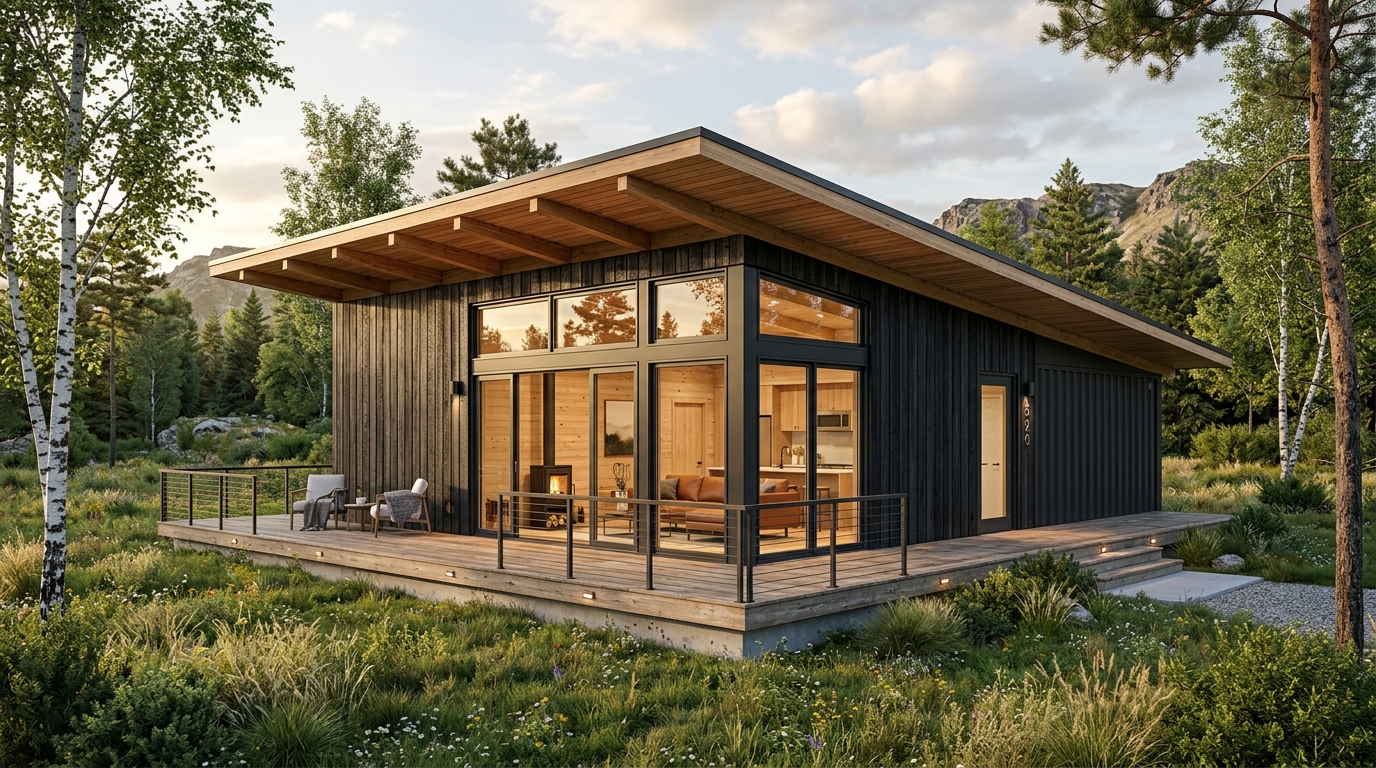
Uninterrupted rectangular gable and monopitch roofs on barndominiums and modern cabins (such as a 30' × 40' or 40' × 60' footprint) provide 650 to 1,300+ sq ft of south- or southwest-facing roof plane with zero valleys or dormers. Even better, 26-gauge standing seam metal roofs accept non-penetrating S-5! seam clamps that bolt solar racking directly to the standing ribs with zero holes drilled through the metal roof.
Step 1: Slashing Daily Kilowatt-Hour Consumption with Closed-Cell Foam & Inverter Heat Pumps
Before sizing solar panels or batteries, the highest-return investment in any off-grid or grid-independent home is reducing thermal HVAC load. A poorly insulated 1,200 sq ft home with electric resistance heat can draw 45 to 65 kWh per winter day. By air-sealing the shell with closed-cell spray foam (R-21 walls / R-49 roof) and installing a 22+ SEER2 cold-climate inverter mini-split heat pump plus a hybrid heat-pump water heater, daily baseline electricity drops to 16 to 24 kWh/day.
Step 2: Sizing the Solar PV Array (kW) and Roof Area Required
Modern 400W to 450W residential monocrystalline solar panels measure roughly 18 to 21 sq ft each (~20 watts per sq ft). On a 30' × 40' barndominium with a 4:12 gable roof, a single 40-foot south-facing roof plane offers ~660 sq ft of unobstructed area—enough to mount 24 to 28 panels (a 10 kW to 12.5 kW solar array) while maintaining code-required 36-inch fire-access perimeter pathways.
In most US regions averaging 4.5 peak sun hours per day, a 10 kW solar array generates 36 to 45 kWh per day—nearly double the daily consumption of a well-insulated 1,200 to 1,800 sq ft barndominium, allowing rapid afternoon recharging after cloudy days.
Step 3: Sizing a 48V LiFePO4 Battery Bank for 2 to 3 Days of Autonomy
Server-rack 48V Lithium Iron Phosphate (LiFePO4) batteries rated for 6,000+ cycles have transformed off-grid economics, now costing roughly $240 to $320 per kWh of storage. For a home consuming 20 kWh per day, a 30 kWh to 45 kWh LiFePO4 battery bank (six to nine 5.12 kWh server-rack modules) paired with dual 12 kW split-phase hybrid inverters provides 48+ hours of silent autonomy plus automatic propane/diesel generator start for multi-day winter storms.